BA's case for orthodoxy

Read and post various viewpoints or search our large archives.

Moderator: Moderator

Forum rules
Be sure to read the Rules/guidelines before you post!
fireofice
Valued contributor
Valued contributor
Posts: 306
Joined: Tue May 22, 2018 1:55 am

Re: BA's case for orthodoxy

Postby fireofice » 1 month 3 weeks ago (Thu Apr 13, 2023 12:15 am)

bombsaway wrote:What is the best example you can find in that book? I haven't seen anything persuasive, but am open to any evidence you can find.

There are several examples of inpatient Jews in the camps. Since they were not gassed at the camp, these are Jews unfit to work that were not gassed. Of course, you could always say they were all deported out (based on nothing), but they were clearly brought to the camp and not killed there. But of course, if you are going to say they were just deported out and not killed there, you are pretty much conceding the holocaust story is false. So that should really make you question whether the rest of thing is actually true.

When the ghettos were closed down across Poland and USSR, unfit Jews were among the population deported from these ghettos. A few Jews remained here, but I think everyone agrees the ghettos were massively depopulated. German documents spell out the majority of Jews being unfit for work. Goebbels: "On the whole it can be said that about 60 percent of them will have to be liquidated (liquidiert) whereas only about 40 percent can be used for forced labor." We know a lot about Jews in German labor camps, but other than Theresienstadt there are no known instances of internment camps where non-working Jews were kept. Why is this?

So you are claiming all Jews "sent to the east" were unable to work? In that case, consult my previous comments about documents talking about non genocidal deportations to the east. If there were Jews that were able to work that were deported to the east and survived, name them. This "where did they go" goes both ways. Prove that there were only "fit Jews" that were deported and survived. If you can't name any, then it's completely fine for me not to name anyone either. You also have no basis for saying there were no alive Jews under Reich detainment that were unable to work. You have not even attempted to demonstrate this. You are now engaging in a "where did they go" argument (a dumb argument to begin with) without demonstrating that anyone necessarily went anywhere to begin with.

User avatar
Butterfangers
Valued contributor
Valued contributor
Posts: 197
Joined: Sun Nov 29, 2020 1:45 am

Re: BA's case for orthodoxy

Postby Butterfangers » 1 month 3 weeks ago (Thu Apr 13, 2023 2:12 am)

bombsaway wrote:When the ghettos were closed down across Poland and USSR, unfit Jews were among the population deported from these ghettos. A few Jews remained here, but I think everyone agrees the ghettos were massively depopulated. German documents spell out the majority of Jews being unfit for work. Goebbels: "On the whole it can be said that about 60 percent of them will have to be liquidated (liquidiert) whereas only about 40 percent can be used for forced labor." We know a lot about Jews in German labor camps, but other than Theresienstadt there are no known instances of internment camps where non-working Jews were kept. Why is this?

Goebbels speaks of Jews being "liquidated" in the same sense that Jews were "liquidated" numerous times before the war progressed, the majority of which instances no one denies had nothing to do with killing. The notion that the word "liquidation" necessarily or even most often means "killing" is an association that was developed post-WW2. This word far more often had to do with dispossession and/or movement or clearance from a given area (much like the interpretation of this word in finance), when referring to a human population, before the mid-20th century.

Moreover, Goebbels is speaking specifically of the General Government in the quote above. '40% can be used for forced labor [in the GG]', i.e. hard labor in the war industries. Others could be liquidated---cleared out, sent further east---for lighter labor and/or resettlement. Moreover, Goebbels offers here what is simply an unofficial, spontaneous "ballpark" estimate based on his own assumptions about how many could or could not work in this area. This is irrelevant as to what percentage actually ended up being used for work in the GG or elsewhere and, frankly, it is absurd to think 60% of even a very weakened/malnourished/aged population could not do anything at all of value (???) at a time when labor was needed across-the-board.

To your question of why "there are no known instances of internment camps where non-working Jews were kept", you first need to better define your timeline. Are you speaking of 1940? 41? 42-43? And in what area? There were the ghettoes for the first part of the war, then many of the less-capable Jews were "liquidated" and sent eastbound, sifted through numerous labor sites (perhaps thousands) and allocated wherever capable or as needed, through the entire route (far beyond the GG-Soviet border into the Eastern territories and all stops along the way). Records in the East were limited to those areas that actually had some level of administration, which naturally ran along the main travel routes and was extremely sparse, in general. Jews that were not needed for labor (and were not likely a threat as partisans, i.e. were weakened/aged/etc.) would not be kept along those main [labor-transport] routes as there was no reason to keep them there. They would be kept as far away from Germans and others as possible to avoid spread of disease, espionage, attempts at terrorism or subversion, etc. There was little need to track them because once the war was in a losing spiral, there was no indication the Germans would retain these territories, hence no need to keep them "Judenfrei". These Jews were simply "pushed far, far away" into whichever spontaneous or makeshift settlements were available, all throughout the vast territories of the East.

One can only imagine what Stalin and his sadistic armies did upon finding these poor souls as the war came to an end. We have every reason to suspect these Jews (already frail and near-death, in many cases) were in extreme danger once captured by the Soviets. All the moreso given the lack of credible evidence that the Germans killed them beforehand at the scenes precisely alleged (AR camps).

bombsaway
Valued contributor
Valued contributor
Posts: 183
Joined: Wed Jan 04, 2023 11:18 am

Re: BA's case for orthodoxy

Postby bombsaway » 1 month 3 weeks ago (Thu Apr 13, 2023 3:38 am)

Butterfangers wrote:
To your question of why "there are no known instances of internment camps where non-working Jews were kept", you first need to better define your timeline. Are you speaking of 1940? 41? 42-43? And in what area?


During and after 42-43 when all the ghettos across Europe were massively depopulated, and it would seem reasonable that internment camps would pop up to absorb some of the large number of displaced Jews -- Ghetto population at its peak is hard to determine but certainly in the millions. Millions were probably displaced, with a minority going to forced labor camps.


There were the ghettoes for the first part of the war, then many of the less-capable Jews were "liquidated" and sent eastbound, sifted through numerous labor sites (perhaps thousands) and allocated wherever capable or as needed, through the entire route (far beyond the GG-Soviet border into the Eastern territories and all stops along the way). Records in the East were limited to those areas that actually had some level of administration, which naturally ran along the main travel routes and was extremely sparse, in general. Jews that were not needed for labor (and were not likely a threat as partisans, i.e. were weakened/aged/etc.) would not be kept along those main [labor-transport] routes as there was no reason to keep them there. They would be kept as far away from Germans and others as possible to avoid spread of disease, espionage, attempts at terrorism or subversion, etc. There was little need to track them because once the war was in a losing spiral, there was no indication the Germans would retain these territories, hence no need to keep them "Judenfrei". These Jews were simply "pushed far, far away" into whichever spontaneous or makeshift settlements were available, all throughout the vast territories of the East.


In your post you mention the 60%of Jews not used for forced labor (this is a low figure, most German documents give higher number ~70%) were resettled or did very light labor. Is there evidence of this? (such as a camp as distinguished from a normal 'forced labor' camp. As a baseline we can see there is a ton of witness and documentary evidence concerning the resettled German Jews (mostly in 41, up until the ghettos they were in were cleared), and the Jews resettled in Transnistria. These were resettlements, where entire communities were moved, and reformed. Transnistria in particular is a good example of 'makeshift' resettlement, because the displaced communities received very little help and were mostly left to their own devices, with some Jews even wandering the countryside and begging for money in cities

User avatar
Hektor
Valuable asset
Valuable asset
Posts: 5168
Joined: Sun Jun 25, 2006 7:59 am

Re: BA's case for orthodoxy

Postby Hektor » 1 month 3 weeks ago (Thu Apr 13, 2023 4:56 am)

Population shifts don't prove 'extermination'.
You would however have a loss in population, if people would have been exterminated of course.

And from the later extermiationists now conclude that, if there was a decrease in population in a territory, this somehow proves extermination. Especially, if it can be linked to other accusation. This is however illogical and not a rational way of reasoning.

Tell us where the 'extermination' supposedly happened and then show us the remains. Treat it like a homicide case.

User avatar
hermod
Valuable asset
Valuable asset
Posts: 2919
Joined: Sun Feb 03, 2013 10:52 am

Re: BA's case for orthodoxy

Postby hermod » 1 month 3 weeks ago (Thu Apr 13, 2023 7:19 am)

bombsaway wrote: I'm just pointing out that even at Theresienstadt, a camp noted in German documents as a 'propagandalager' and a place whose purpose was "to save face with the outside world" there's no evidence of an unfit Jewish population being maintained.


Did some German wartime documents really call the Theresienstadt ghetto a propagandalager (propaganda camp)? I ask this question because Holocaustians often try to strenghten their case with the lie that there exist some German wartime documents with the words Vernichtungslager (extermination camp),Todeslager (death camp) and Tötungszentren (killing centers) when those words are rather German postwar translations of some English terms coined by Allied propagandists and sykewarriors for deception purposes.

Extermination camp

From Wikipedia, the free encyclopedia
Not to be confused with Nazi concentration camps.

Nazi Germany used six extermination camps (German: Vernichtungslager), also called death camps (Todeslager), or killing centers (Tötungszentren), in Central Europe during World War II to systematically murder over 2.7 million people – mostly Jews – in the Holocaust.[1][2][3]

https://en.wikipedia.org/wiki/Extermination_camp


P.S. Anyway, before and during WWII, the German word propaganda didn't imply lies and deception as the English word "propaganda" did at that time. The English word "propaganda" gained that negative connotation during the interwar era, when the best propaganda lies of Allied propagandists during WWI were finally admitted by former insiders and exposed by revisionist historians.


"[Austen Chamberlain] has done western civilization a great service by refuting at least one of the slanders against the Germans
because a civilization which leaves war lies unchallenged in an atmosphere of hatred and does not produce courage in its leaders to refute them
is doomed.
"

Deutsche Allgemeine Zeitung, on the public admission by Britain's Foreign Secretary that the WWI corpse-factory story was false, December 4, 1925

User avatar
Hektor
Valuable asset
Valuable asset
Posts: 5168
Joined: Sun Jun 25, 2006 7:59 am

Re: BA's case for orthodoxy

Postby Hektor » 1 month 3 weeks ago (Thu Apr 13, 2023 1:20 pm)

hermod wrote:
bombsaway wrote: I'm just pointing out that even at Theresienstadt, a camp noted in German documents as a 'propagandalager' and a place whose purpose was "to save face with the outside world" there's no evidence of an unfit Jewish population being maintained.


Did some German wartime documents really call the Theresienstadt ghetto a propagandalager (propaganda camp)? I ask this question because Holocaustians often try to strenghten their case with the lie that there exist some German wartime documents with the words Vernichtungslager (extermination camp),Todeslager (death camp) and Tötungszentren (killing centers) when those words are rather German postwar translations of some English terms coined by Allied propagandists and sykewarriors for deception purposes.

If you say it was called a propagandalager, show us the document then.

Indeed, they change the name and designation as they like. And they do it in a way that people think that it was called that in the documents, too.

hermod wrote:
Extermination camp
....


P.S. Anyway, before and during WWII, the German word propaganda didn't imply lies and deception as the English word "propaganda" did at that time. The English word "propaganda" gained that negative connotation during the interwar era, when the best propaganda lies of Allied propagandists during WWI were finally admitted by former insiders and exposed by revisionist historians.
...


The German usage of propaganda was more like what today would be called 'promotion'. All parties called their marketing and recruitment arms and activities 'propaganda'. The term propaganda stems from the Catholics I think, as a way of promoting Catholicism. And they used to be quite clever with this.

The negative connotation of propaganda unfolded after WW2. It's however associated with explicit and recognizable propaganda. That tactic has mostly been dropped as it is ineffective. It's far more effective to use materials for propaganda that look sober, scholarly and objective on the surface. There is however tricks with the editing and the wording being used. And that's where it gets really deceptive.

WW1 propaganda was quite crude and actually recognizable as such. WW2 was a bit more cleverly done, but also recognizable, if you know what to look for. Post WW2 propaganda is done by professionals that know how to maintain an image of 'being informative' and being 'serious'... but there is lots of repetition and association, too. If you look through the backgrounds of journalists, you'll notice that the bias is usually heavily leftists, but even the conservatives have bought into leftist precepts. And that level of control was unknown in the first half of the 20th century. I think it only changed after the 1960s.

User avatar
hermod
Valuable asset
Valuable asset
Posts: 2919
Joined: Sun Feb 03, 2013 10:52 am

Re: BA's case for orthodoxy

Postby hermod » 1 month 3 weeks ago (Thu Apr 13, 2023 6:52 pm)

Hektor wrote:The German usage of propaganda was more like what today would be called 'promotion'.


Every people's usage of propaganda was like that.


Hektor wrote:The negative connotation of propaganda unfolded after WW2.


In English-speaking countries, it unfolded after WW1 due to the very widespread use of big lies and distortions by British propagandists during that war and to the numerous admissions on that fact after that war. Ironically, it helped the British propagandists a lot during WWII because they could easily portray Goebbels as a liar, the title "Minister of Propaganda" having distinct meanings in English and in German. Since the word "propaganda" hadn't been degraded by WW1 in Germany and the non-English-speaking countries, there was no reason for NS Germany not to have a Ministry of Propaganda. But the name of such a ministry was of course a godsend for British rulers. A regime doesn't even need to contradict the statements made by a country with a ministry misunderstood as a ministry of lies and deception, isn't it?


Hektor wrote:It's however associated with explicit and recognizable propaganda. That tactic has mostly been dropped as it is ineffective. It's far more effective to use materials for propaganda that look sober, scholarly and objective on the surface. There is however tricks with the editing and the wording being used. And that's where it gets really deceptive.

WW1 propaganda was quite crude and actually recognizable as such. WW2 was a bit more cleverly done, but also recognizable, if you know what to look for.


WW1 propaganda was not explicit and recognizable. And it was not crude at all. It was made by Britain's finest authors and opinion-makers and inserted in newspapers, books, broadcasts and films as real news and information. And it was believed by most people. That's why everybody felt so humiliated, betrayed and hostile to the Allied diktats when the British wartime tricks and lies were finally revealed. And that's also why WW2 propagandists didn't reveal their tricks and lies after the war.

I wouldn't call WW2 propaganda less crude and more subtle than WW1 propaganda. Showing shocking photos of a health disaster in order to "prove" that the enemy was a bloodthirsty barbarian who deserved firebombings and perpetual subjugation is very crude if I'm asked. WW2 propagandists were like hardcore pornographers and WW1 were like erotica writers, successfully arousing their readers with mere words (because graphic atrocity propaganda was banned). Just like porn, WW2 propaganda was very efficient but not subtle.
"[Austen Chamberlain] has done western civilization a great service by refuting at least one of the slanders against the Germans
because a civilization which leaves war lies unchallenged in an atmosphere of hatred and does not produce courage in its leaders to refute them
is doomed.
"

Deutsche Allgemeine Zeitung, on the public admission by Britain's Foreign Secretary that the WWI corpse-factory story was false, December 4, 1925

Merlin300
Valued contributor
Valued contributor
Posts: 337
Joined: Wed Nov 08, 2017 2:21 pm

Re: BA's case for orthodoxy

Postby Merlin300 » 1 month 3 weeks ago (Thu Apr 13, 2023 7:52 pm)

fireofice wrote:


Why wouldn't anyone publish stories of Jews being kept in internment type camps? Walk me through the mindset of a researcher or publisher who hears one of these stories.


Hello, The mindset of researchers can be show from Camp Westerbork, in Holland.
Thousands of German and Dutch Jews spent the War in the camp with a total death rate of 3%.
See https://kampwesterbork.nl/en/history/se ... -1940-1942

However, the claim now is that Westerbork was known during the War as "The GATEWAY TO HELL."
In short, very few researchers have the courage to mention any facts inconvenient to the Holocaust Tale.

By the way, academics are usually the last to risk their reputation on anything controversial.

User avatar
Butterfangers
Valued contributor
Valued contributor
Posts: 197
Joined: Sun Nov 29, 2020 1:45 am

Re: BA's case for orthodoxy

Postby Butterfangers » 1 month 3 weeks ago (Thu Apr 13, 2023 8:29 pm)

bombsaway wrote:During and after 42-43 when all the ghettos across Europe were massively depopulated, and it would seem reasonable that internment camps would pop up to absorb some of the large number of displaced Jews -- Ghetto population at its peak is hard to determine but certainly in the millions. Millions were probably displaced, with a minority going to forced labor camps.

It's already been said but here it is again: There were over 40,000 camps and collection sites, the vast majority of which never were identified by name or by their respective characteristics.

That indicates an unknown number of sites where less-abled Jews were interned.

Of most labor camps for Jews which are identified in some way (which are only a tiny fraction of the overall number that existed), we don't know the nature or scope of work that was done there (neither in the GG nor further East). This leaves plenty of room for less-demanding work to have been performed across Europe by Jews who were "unfit for work" in the GG or in a more general context.

If you cannot name all of these camps (or even a sizeable fraction of them), why should I? We know they existed. And that's a gaping hole in the suggestion that Jews could have gone nowhere but underneath Treblinka.

Of those Jews that were truly decrepit and completely unable to do any work of any kind, we have three possibilities, re: documentation:

(1) there was no reason or desire to document the final placement of these "useless", non-threatening individuals,
(2) the [few] documents that did possibly exist were made to disappear by someone(s), probably post-war
(3) all the Jews in question were gassed and buried in precisely-known locations at AR camps.

You have all of your chips on #3, despite the conflicted interests and patterns of deception which permeate this subject within that position, and a total lack of physical evidence.

Revisionists tend to find #1 and #2 more plausible, for obvious reasons (made even more obvious by the behavior of Jewish networks and governments well-into present-day). And of course, this question of "Aktion Reinhard Jews" doesn't exist in a vacuum. It has to be weighted alongside allegations of events in places like Auschwitz-Birkenau, which are said to be of the same nature and policy. Most would agree, if it were ever generally accepted that the Auschwitz 'gassings' were indeed a hoax, few would keep their belief in Treblinka, Sobibor, Belzec. The question of which "side" the liars were on would become clear and those common appeals to 'authority' would fall apart.

In your post you mention the 60%of Jews not used for forced labor (this is a low figure, most German documents give higher number ~70%)


You refer to "most German documents" giving a "higher number ~70%". Please provide examples of these German documents you have in mind.

[Jews] were resettled or did very light labor. Is there evidence of this? (such as a camp as distinguished from a normal 'forced labor' camp.


Nearby along the eastbound route across the GG-Soviet border, there were known labor sites where light labor was performed (e.g. laundries, warehousing/sorting, shoemakers, tailors, carpentry). This included Koldychevo, Slonim, Novogroduk, all of which align on the same route toward Minsk, where even more light labor opportunities were available (e.g. assembly work). Of course, all of this leaves out the fact that there are thousands of camps we remain entirely unaware of but which are known to have existed. So, in short, yes, there is absolutely evidence of "this". There is much more evidence of "this" than there is of even a small fraction of 1.2 million persons' worth of bone meal underneath the AR camps.

As a baseline we can see there is a ton of witness and documentary evidence concerning the resettled German Jews (mostly in 41, up until the ghettos they were in were cleared), and the Jews resettled in Transnistria. These were resettlements, where entire communities were moved, and reformed. Transnistria in particular is a good example of 'makeshift' resettlement, because the displaced communities received very little help and were mostly left to their own devices, with some Jews even wandering the countryside and begging for money in cities


Your suggestion that documentation of resettlement of German Jews and those in Transnistria should be comparable to that of those in the Baltic States and other parts of Ukraine is a question of the scale of any formal administration and the centralization and recording functions thereof. There was little administrative organization to work with in most parts of Ukraine and the Baltic states, compared to Transnistria which was right outside of Romania and occupied relatively early-on. Resettlement of Jews from the GG occurred more than a year later (in devastating wartime), to places with little administrative structure, under greater need for secrecy (i.e. more central to the confiscation-operation of Aktion Reinhard & the final solution expulsion policy), with far less incentive or reason in documenting where the subjects ultimately went (given the chaos and circumstances of war, among other factors).

These are not comparable.

User avatar
Butterfangers
Valued contributor
Valued contributor
Posts: 197
Joined: Sun Nov 29, 2020 1:45 am

Re: BA's case for orthodoxy

Postby Butterfangers » 1 month 3 weeks ago (Thu Apr 13, 2023 9:09 pm)

I'll add to my last post that Transnistria had one of the highest Jewish populations and densities in all of Europe at the time (it included the infamous Jewish power-center of Odessa), all the more so contributing to the significance, frequency and number of reports, overall.

User avatar
Hektor
Valuable asset
Valuable asset
Posts: 5168
Joined: Sun Jun 25, 2006 7:59 am

Re: BA's case for orthodoxy

Postby Hektor » 1 month 3 weeks ago (Fri Apr 14, 2023 3:21 am)

hermod wrote:....
Hektor wrote:The negative connotation of propaganda unfolded after WW2.


In English-speaking countries, it unfolded after WW1 due to the very widespread use of big lies and distortions by British propagandists during that war and to the numerous admissions on that fact after that war. Ironically, it helped the British propagandists a lot during WWII because they could easily portray Goebbels as a liar, the title "Minister of Propaganda" having distinct meanings in English and in German. Since the word "propaganda" hadn't been degraded by WW1 in Germany and the non-English-speaking countries, there was no reason for NS Germany not to have a Ministry of Propaganda. But the name of such a ministry was of course a godsend for British rulers. A regime doesn't even need to contradict the statements made by a country with a ministry misunderstood as a ministry of lies and deception, isn't it?
One would have to look at the admissions being made. And how the perception of the term propaganda changed over time. Many may have indeed become more suspicious of the term. And the British had their own propaganda-ministry the "Ministry of Information". The choice of words did matter there.

On the other hand: If someone explicitly tells you that 'this is my propaganda' than he isn't even trying to deceive you, since he openly admits that this is his POV.

hermod wrote:....
Hektor wrote:It's however associated with explicit and recognizable propaganda. That tactic has mostly been dropped as it is ineffective. It's far more effective to use materials for propaganda that look sober, scholarly and objective on the surface. There is however tricks with the editing and the wording being used. And that's where it gets really deceptive.

WW1 propaganda was quite crude and actually recognizable as such. WW2 was a bit more cleverly done, but also recognizable, if you know what to look for.


WW1 propaganda was not explicit and recognizable. And it was not crude at all. It was made by Britain's finest authors and opinion-makers and inserted in newspapers, books, broadcasts and films as real news and information. And it was believed by most people. That's why everybody felt so humiliated, betrayed and hostile to the Allied diktats when the British wartime tricks and lies were finally revealed. And that's also why WW2 propagandists didn't reveal their tricks and lies after the war.

I wouldn't call WW2 propaganda less crude and more subtle than WW1 propaganda. Showing shocking photos of a health disaster in order to "prove" that the enemy was a bloodthirsty barbarian who deserved firebombings and perpetual subjugation is very crude if I'm asked. WW2 propagandists were like hardcore pornographers and WW1 were like erotica writers, successfully arousing their readers with mere words (because graphic atrocity propaganda was banned). Just like porn, WW2 propaganda was very efficient but not subtle.


I was talking about the crude pamphleteering. This was still recognizable as such. And I recall that people also said so in interviews. They knew, it's probably false, "but necessary". The run of the mill private would still be influenced by this, though.

The engagement of authors of literature is of course another matter. There it wasn't clear that they were working for the government and the war effort. They were seen as objective, often critical of the government as well.

As far as Holocaust related stuff is concerned... Many people remained skeptical, especially because parts of it were crude and pushy. What may have persuaded them, was the fact that reputable authors joined into the choir there. Assuming that they must have verified the claims. It's a bit like people starting to believe in COVID, after their doctors told them about cases. They then assumed the doctors could 'see that the virus had done it' and 'distinguish it from mass psychogenic illness' and 'other diseases'. Which was nonsense, but when people are distressed and confused they tend to grasp to authority figures and 'trust their judgement'.

The Americans established the IfZ in Germany knowing fairly well, that people would remain suspicious as long as their propaganda material was the sole source for 'Nazi-atrocities'. With the IfZ it looks "Scientific" and also acceptable for most academics, who subsequently believe what the IfZ is asserting. I'd say that Ernst Nolte and colleagues did believe what the IfZ was publishing including the assumptions being made. His approach was rather to view NS-concentration camps not as 'isolated', but that there was a prehistory for this hinting at the GULAG and communist atrocities.

Nolte wasn't taken on by other historians, but by the epigones of the Frankfurt School like Juergen Habermas. That settled then the Historikerstreit 'for good'. Other historians saw the treatment that Ernst Nolte got and hence dropped the ball on questioning the narrative at least publicly. I know a German phD in history that told me exactly that. The better historians on phD level mostly know that the evidence for 'the Holocaust' is dubious and that a lot of the claims being made are propaganda claims with a high likelihood of falsehood. So they rather stay away from the subject and focus on their area of interest (which isn't the Holocaust). They also would admit this in private, but would never do so publicly or in writing. To them it's not worth the risk and the emotional distress this would cause, for them, their families and friends. They fear the emotional responses of the believers. And the envy of their colleagues who may use the opportunity to get rid of a competitor for funding by attacking this colleagues reputation. So you get the situation were the Holocaust Myth has become self-enforcing.

Meanwhile Morris Janowitz stipulated publicly and clearly that the atrocity propaganda (he doesn't use the word, but euphemisms) had the goal of 'reeducating the Germans':
https://archive.org/details/MorrisJanow ... Atrocities

And it didn't stay there, similar methods were used to brainwash other populations in Western Europe and the United states and by extension other Western countries over times. That is why the Eastern Europeans aren't receptive for the manipulation efforts than the Western Europeans are. They especially distrust what comes from governments. But they are not articulate themselves so it stays there and even over time the Eastern European societies may change.

A dedicated effort to challenge atrocity propaganda and manipulation techniques may however result in a change of course. The issue then would be that many people are not reachable for reason anymore.

bombsaway
Valued contributor
Valued contributor
Posts: 183
Joined: Wed Jan 04, 2023 11:18 am

Re: BA's case for orthodoxy

Postby bombsaway » 1 month 3 weeks ago (Fri Apr 14, 2023 5:57 am)

Butterfangers wrote:You refer to "most German documents" giving a "higher number ~70%". Please provide examples of these German documents you have in mind.


Mattogno quotes some here https://codoh.com/library/document/the- ... may-to/en/

»According to the experiences so far these transports will consist of an estimated 30% (in this case about 3,600) employable Jews […]«


Regarding Transnistria (Moldavian ASSR, incorporated into USSR in 1924, and technically part of Soviet Ukraine) the evidence difference couldn't be more stark. There are zero German documents that shed any light on the fate of 'resettled' deportees in German territory, whereas in Transnistria there are at least hundreds (I quoted a partial dossier earlier). There are also diaries and letters that describe the situation, a good example is this
https://webcache.googleusercontent.com/ ... clnk&gl=us

I think what you guys are alleging happened is unprecedented. In modern times (say the last 200 years) mass population movements have always been traceable in terms of record, at least to some degree.

And that's a gaping hole in the suggestion that Jews could have gone nowhere but underneath Treblinka.


It's not a process of elimination for me but rather that there is much more evidence for the mass killing hypothesis than anything else. The documentary case is bad, because all pronouncements about resettlement are sufficiently vague that the "code word hypothesis" is possible - no specifics are ever given. The witness case is virtually non-existent.

You have raised the possibility that they could have been put in resettlement camps or deposited in the countryside, but this does not mean it actually happened. I could also suggest that there was a mass killing at Treblinka of Jews unfit for work. It would make sense for the Nazis to kill people who offered them no economic value and were actually a burden in terms of having to feed and house and guard. But I would not believe this if there wasn't any evidence for it. I take an evidence based approach to history, so even a compelling narrative is worthless if there's no direct corroboration.

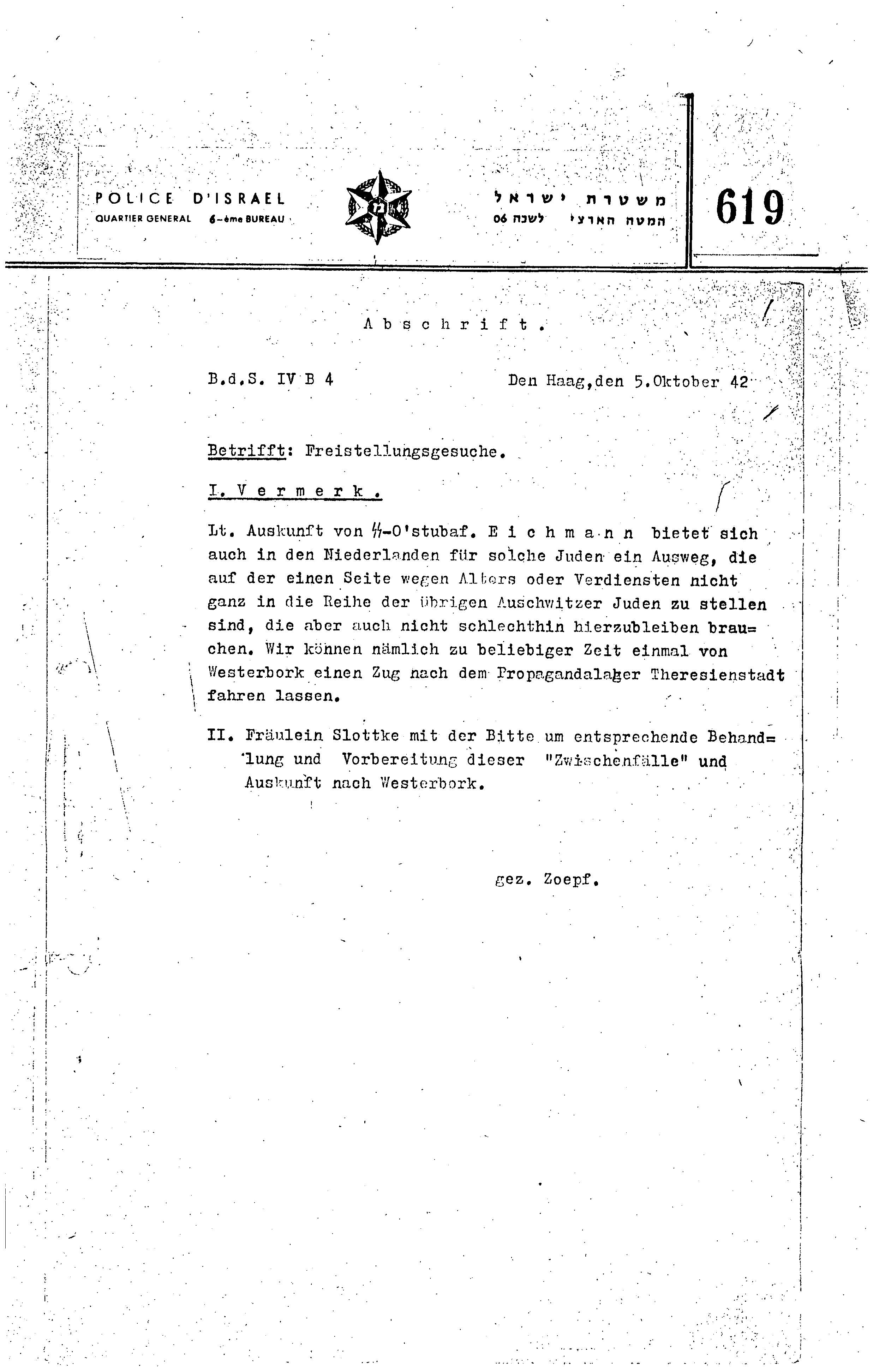
'Propogandalager' Theresienstadt :
ujPpLY0.jpg

User avatar
Hektor
Valuable asset
Valuable asset
Posts: 5168
Joined: Sun Jun 25, 2006 7:59 am

Re: BA's case for orthodoxy

Postby Hektor » 1 month 3 weeks ago (Fri Apr 14, 2023 7:28 am)

bombsaway wrote:....
You have raised the possibility that they could have been put in resettlement camps or deposited in the countryside, but this does not mean it actually happened. I could also suggest that there was a mass killing at Treblinka of Jews unfit for work. It would make sense for the Nazis to kill people who offered them no economic value and were actually a burden in terms of having to feed and house and guard. But I would not believe this if there wasn't any evidence for it. I take an evidence based approach to history, so even a compelling narrative is worthless if there's no direct corroboration.

Yet they kept 100.000s (plus) of people alive that were an economic burden to them.

Corpse/human remains = evidence for a person having died. Having been killed is another matter.
But a dead person doesn't say why it was killed or why it died. And one can not extrapolate from this that more people were killed neither. Yet this is exactly how the Holocaust narrative was constructed.

bombsaway wrote:.
'Propogandalager' Theresienstadt :
ujPpLY0.jpg


Was that document written by a German? How do you know, if it is an original German document?


In an original document you would reasonably expect:
* formally correct German as a German speaker at the time would have used it.
* Official assignations of the objects, e.g. a camp or location.

Now that means that there must have been documents with the official documents. Somebody calling something 'propagandalager' without this is highly suspicious. Due to the Theresienstadt documentary made during the war, the camp got the name of being staged for propaganda. But who did they want to impress with this? Why would they do so?

The thing is that people that tried to push the Holocaust narrative anxiously were embarrassed by Theresienstadt big time.

Masur said that Himmler mentioned Theresienstadt (that the plan was to have all camps/Ghettoes like this).

User avatar
borjastick
Valuable asset
Valuable asset
Posts: 3233
Joined: Fri Aug 26, 2011 5:52 am
Location: Europe

Re: BA's case for orthodoxy

Postby borjastick » 1 month 3 weeks ago (Fri Apr 14, 2023 8:09 am)

The photo of the document number 619 in the top right hand corner doesn't make sense to me. Could someone please translate?

It is in French top left and say Police of Israel. But israel didn't exist in 1942 so what was this paper all about? Where did it originate and why does it have several languages at the top and the text in German?
'Of the four million Jews under Nazi control in WW2, six million died and alas only five million survived.'

'We don't need evidence, we have survivors' - israeli politician

User avatar
Butterfangers
Valued contributor
Valued contributor
Posts: 197
Joined: Sun Nov 29, 2020 1:45 am

Re: BA's case for orthodoxy

Postby Butterfangers » 1 month 3 weeks ago (Fri Apr 14, 2023 2:33 pm)

bombsaway wrote:Mattogno quotes some here https://codoh.com/library/document/the- ... may-to/en/

»According to the experiences so far these transports will consist of an estimated 30% (in this case about 3,600) employable Jews […]«

You don't seem to be making any distinction between the following:

  • Jews capable of working in the General Government
  • Hungarian Jews capable of working in Auschwitz and/or Austria
  • Jews capable of working in Eastern-occupied territories
  • Jews capable of doing any work of any kind, anywhere

Your latest reference is specifically to Hungarian Jews and their employability within the context of Austrian camps and/or Auschwitz. If you would actually read the article you provided, you'd also see the following:

Straßhof was certainly a special case, but it should be noted, that in Austria also inmates were conscripted to work who were theoretically not able to work. S. Szabolcs published a letter of the Technical Emergency Help. Office Bad-Vöslau to BdS and SD., Sondereinsatzkommando for Hungarian Jews, Aussenkommando Vienna II, which mentions a list of 42 Hungarian Jews who were working »for the construction of a SS-hospital since October 1, 1944«. This letter mentions further: [52]

»These Jews are from the camp Straßhof and worked in Klein-Mariazell and Bernhof for the construction of temporary housings after the catastrophic thunder-storms.«

These were therefore people who were actually employed to work. The lists mentions 13 Jews with over 70 years, one each of 15, 13 and 10 years, two of eight and one of four years. The oldest, Arnold Singer, born March 28, 1868 was 76 years old, the youngest, Agnes Anisfeld, born August 31, 1940, counted 4 years.

Hence, even in Austria, "unfit for work" did not necessarily mean "never actually put to work". Even children and elderly were conscripted into construction work. Surely, the same flexibility applied to the Jews offboarded into the Eastern-occupied territories as well. Jews were employed wherever and whenever they could perform tasks that could be deemed useful, which was quite often.

Regarding Transnistria (Moldavian ASSR, incorporated into USSR in 1924, and technically part of Soviet Ukraine) the evidence difference couldn't be more stark. There are zero German documents that shed any light on the fate of 'resettled' deportees in German territory, whereas in Transnistria there are at least hundreds (I quoted a partial dossier earlier). There are also diaries and letters that describe the situation, a good example is this
https://webcache.googleusercontent.com/ ... clnk&gl=us

I think what you guys are alleging happened is unprecedented. In modern times (say the last 200 years) mass population movements have always been traceable in terms of record, at least to some degree.

It is difficult to believe you are approaching any of this honestly when the facts which contradict your position are so glaringly obvious to anyone who stops to think about it for five minutes. You are correct that the "evidence difference" is stark but you have disregarded the administrative difference between these distinct movements. Let's recap:

  • the formal administration and the centralization and recording functions were very strong in Transnistria, given the proximity to Romania and occupation early-on
  • on the other hand, administrative networks were almost non-existent in most of the Eastern-occupied territories due to many being occupied late in the war, geographical factors, and having little or no pre-existing administration to work with
  • Transnistria already had a large Jewish population before the deportations began due to large, historical Jewish communities in the vicinity.

Altogether, you have some 250,000 Jews condensed into one well-administered location, in the case of Transnistria.

By comparison, for Jews deported East from AR camps, you have some unknown number of Jews at any given location but likely at least multiple hundreds of thousands spread out over likely thousands of locations in a territory almost as large as the continental United States who... and here's the kicker... would be captured by the Soviets and stuck behind a notorious "Iron Curtain" (i.e. no information out or in) within the next 1-2 years!

And again, Germany had no reason to document these placements anyway. In fact, they probably wanted them thoroughly covered up. In addition to the controversy of their confiscation operation with respect to international law, they did not want these Jews back after the war. Hence, any records of them having ever been transferred to these sites in the East would have been undesirable. Keeping such records would have been difficult, in any case, due to the administrative limitations already outlined.

And that's a gaping hole in the suggestion that Jews could have gone nowhere but underneath Treblinka.


It's not a process of elimination for me but rather that there is much more evidence for the mass killing hypothesis than anything else. The documentary case is bad, because all pronouncements about resettlement are sufficiently vague that the "code word hypothesis" is possible - no specifics are ever given. The witness case is virtually non-existent.


Let's stop playing this game where you pretend you are an objective instigator, really just trying to get to the bottom of things and have happened to conclude based upon an honest weighting of evidence that the establishment position is better supported. Your agenda here is thinly-veiled and transparent. I continue to engage with you only because it gives an opportunity to exhibit the facts to those who will later stumble upon this forum.

You ignore (literally do not even address) the evidence which quite clearly invalidates your position. I have broken this down already (administrative factors, diffusion/dispersion, motivations to document or lack thereof, cover-ups, Allied victory and handling of evidence, Soviet factors, etc.). You ignore all of this, suggest there should still be additional documentation, despite that any one or two of these factors could be sufficient to explain why it might be so limited.

And meanwhile, the earthworms still chew through the rich, bone-free soil all throughout Treblinka, Sobibor, and [most of] Belzec.

You have raised the possibility that they could have been put in resettlement camps or deposited in the countryside, but this does not mean it actually happened. I could also suggest that there was a mass killing at Treblinka of Jews unfit for work. It would make sense for the Nazis to kill people who offered them no economic value and were actually a burden in terms of having to feed and house and guard. But I would not believe this if there wasn't any evidence for it. I take an evidence based approach to history, so even a compelling narrative is worthless if there's no direct corroboration.


You can offer up whatever narrative of mass killing events you'd enjoy whipping up in the kitchen, feel free to do so, but, "I could also suggest that there was a mass killing at Treblinka... it would make sense for the Nazis to kill people..." is not how criminal investigations and convictions are supposed to work. It is you---not I---who needs proof.


Return to “'Holocaust' Debate / Controversies / Comments / News”

Who is online

Users browsing this forum: Archie and 9 guests