
I found this article yesterday in the Guardian newspaper. It's a little strange I think.
It concerns this little chappie Benjamin Ferencz
The chief prosecutor for the US in the case was former army sergeant Benjamin Ferencz. It was his first trial, and he was 27 at the time.
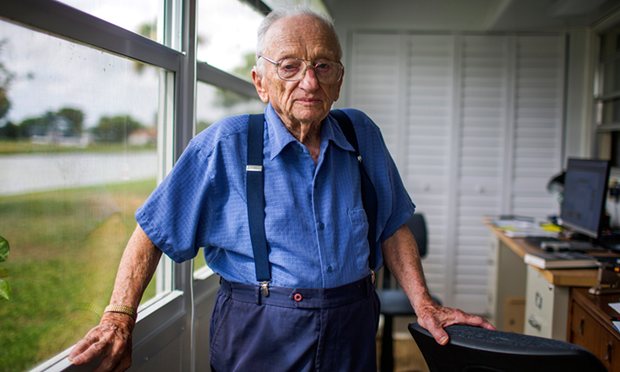
- Ferencz.jpg (44.52 KiB) Viewed 2097 times
https://www.theguardian.com/law/2017/fe ... in-ferencz
In 1945, as Nazi atrocities were uncovered, Ferencz was transferred to the headquarters of General Patton’s third army, tasked with setting up a new war-crimes branch. He was present at, or arrived soon after, the liberation of concentration camps including Buchenwald, Mauthausen, Flossenbürg and Ebensee, scouring the barbarous scenes for evidence of Nazi wrongdoing to present at trial. The most significants items he collected, he says, were the death registries, kept as meticulously by the Germans as hospital birth certificates.
Obviously he was not present at the liberation of any of the so called 'death camps' neither had he been to see any of the locations claimed for the mass murderous shootings of the Einsatzgruppen. Plus of course being jewish he could hardly have been an honest broker, an impartial observer. Nor could he, at the tender age of 27, have the necessary skills and experience to bring to bear. Yet he claims he was Chief Prosecutor on behalf of the US govt. in the case of The United States of America vs. Otto Ohlendorf, et al. as it was officially known.
I read what wikipedia has to say about the trial and will continue reading on the subject.
Here's the wiki web page url; https://en.wikipedia.org/wiki/Einsatzgruppen_trial
Can anyone shed more light on this bloke and the trial and lack of evidence?
Ferencz says there were 22 defendants but the record shows 24, but that could be a simple admin error.
The page says that a full investigation was carried out to define the evidence etc but yet again we see no actual evidence of bodies, mass graves, location details and so on.
The judgement was quite powerful.
The Nuremberg Military Tribunal in its judgement stated the following:
[The facts] are so beyond the experience of normal man and the range of man-made phenomena that only the most complete judicial inquiry, and the most exhaustive trial, could verify and confirm them. Although the principal accusation is murder, [...] the charge of purposeful homicide in this case reaches such fantastic proportions and surpasses such credible limits that believability must be bolstered with assurance a hundred times repeated.
...a crime of such unprecedented brutality and of such inconceivable savagery that the mind rebels against its own thought image and the imagination staggers in the contemplation of a human degradation beyond the power of language to adequately portray.
The number of deaths resulting from the activities with which these defendants have been connected and which the prosecution has set at one million is but an abstract number. One cannot grasp the full cumulative terror of murder one million times repeated.
It is only when this grotesque total is broken down into units capable of mental assimilation that one can understand the monstrousness of the things we are in this trial contemplating. One must visualize not one million people but only ten persons — men, women, and children, perhaps all of one family — falling before the executioner's guns. If one million is divided by ten, this scene must happen one hundred thousand times, and as one visualizes the repetitious horror, one begins to understand the meaning of the prosecution's words, 'It is with sorrow and with hope that we here disclose the deliberate slaughter of more than a million innocent and defenseless men, women, and children.'[1]
I am always confused by the sentences handed down. In this case of the twenty four men found guilty many were sentenced to death but only four actually faced the drop. The rest were given fairly long terms, though not if one considers they were convicted of one million murders, but then let go after relatively short time served. Eg;
Heinz Jost SS Brigadeführer; member of the SD; commanding officer of Einsatzgruppe A Lifetime imprisonment commuted to 10 years; died 1964.
I feel quite strongly that the trials were a way of showing vengeance and control but in reality the western governments knew they had little or no evidence to go on, they probably knew the truth was far from what had been claimed and let these men and many others in the Nuremberg trials go quietly after between 5-10 years. All very odd in my opinion.